Shopify Dropshipping Apps: 12 Best for 2026
Disclosure: This post may contain affiliate links. We earn a commission at no extra cost to you.
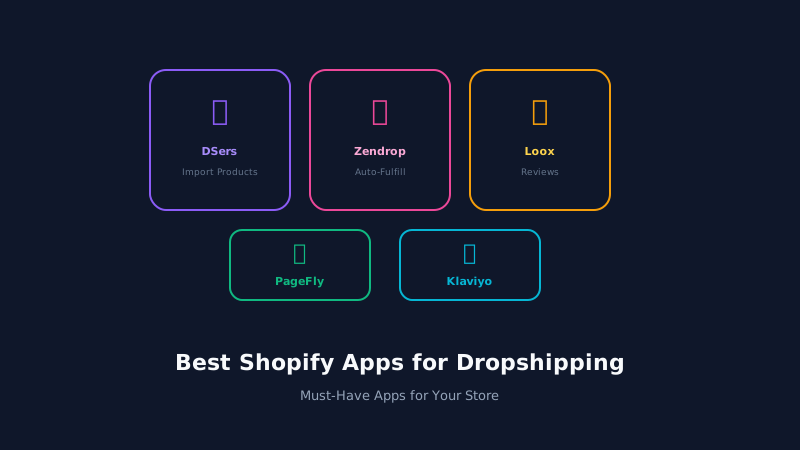
Shopify dropshipping apps fall into a few clear jobs in 2026: sourcing and fulfillment, building high-converting pages, choosing a fast theme, email and SMS marketing, collecting reviews, and increasing order value with upsells. You don't need all of them at once, you need the right one for each job.
Below are 12 apps worth knowing, grouped by what they actually do, with honest notes on pricing and who each one is for. If you haven't built your store yet, start your free Shopify trial first, every app here installs in a couple of clicks from the Shopify App Store.
Sourcing & fulfillment apps (the core of any dropshipping store)
These connect your store to suppliers, import products, and automate order fulfillment. This is the one category you cannot skip.
1. DSers: best free AliExpress fulfillment app
DSers is the official AliExpress dropshipping partner and the most popular order-management tool for beginners. It lets you import products, fulfill hundreds of orders in a few clicks (bulk ordering), sync tracking automatically, and find cheaper or faster suppliers for the same product.
- Pricing: Free plan covers multiple stores and thousands of products. Paid plans start around $19.90/month for advanced automation, scaling up for larger catalogs.
- Best for: Anyone sourcing from AliExpress who wants to keep costs near zero while testing products.
If you're weighing where to source from, our guides on the best dropshipping suppliers and best AliExpress alternatives pair well with DSers.
2. CJ Dropshipping: best all-in-one sourcing and faster shipping
CJ Dropshipping goes beyond simple imports. It's a full sourcing partner with US, EU, and China warehouses, a product-sourcing service for items you can't find elsewhere, automated order fulfillment, and optional custom packaging and branding to make your store feel less generic.
- Pricing: The app is free to install: you only pay product and shipping costs (billed in USD). No monthly subscription required.
- Best for: Sellers who want faster shipping options, private sourcing, and branding without an upfront software fee.
Because there's no subscription, CJ is one of the few genuinely functional free fulfillment options for a first store.
3. Zendrop: best for US-based, beginner-friendly automation
Zendrop focuses on simplicity and faster US delivery, with a large catalog, custom branding, and print-on-demand. The interface is clean, which beginners appreciate.
- Pricing: A free Starter tier lets you explore the platform, but importing and fulfilling orders requires a paid plan: the Pro plan is around $49/month, with a higher Plus tier. Note that signing up through the Shopify App Store can put you on usage-based billing rather than a flat rate, so read the terms before you scale.
- Best for: US-focused stores that value an easy interface and built-in branding.
4. Spocket: best for fast US & EU shipping
Spocket specializes in vetted US and EU suppliers, which means shipping times closer to 2-7 days instead of weeks. That's a real advantage if you sell to Western customers and want fewer "where's my order?" tickets.
- Pricing: No free plan beyond a short trial. Paid tiers start around $24/month (billed annually) for the Pro plan and rise from there; watch the regular monthly rates, which are higher.
- Best for: Stores prioritizing fast, reliable shipping and willing to accept higher product costs for it.
5. Doba: best AI-assisted sourcing with US warehouses
Sponsored placement. The assessment below is our own.
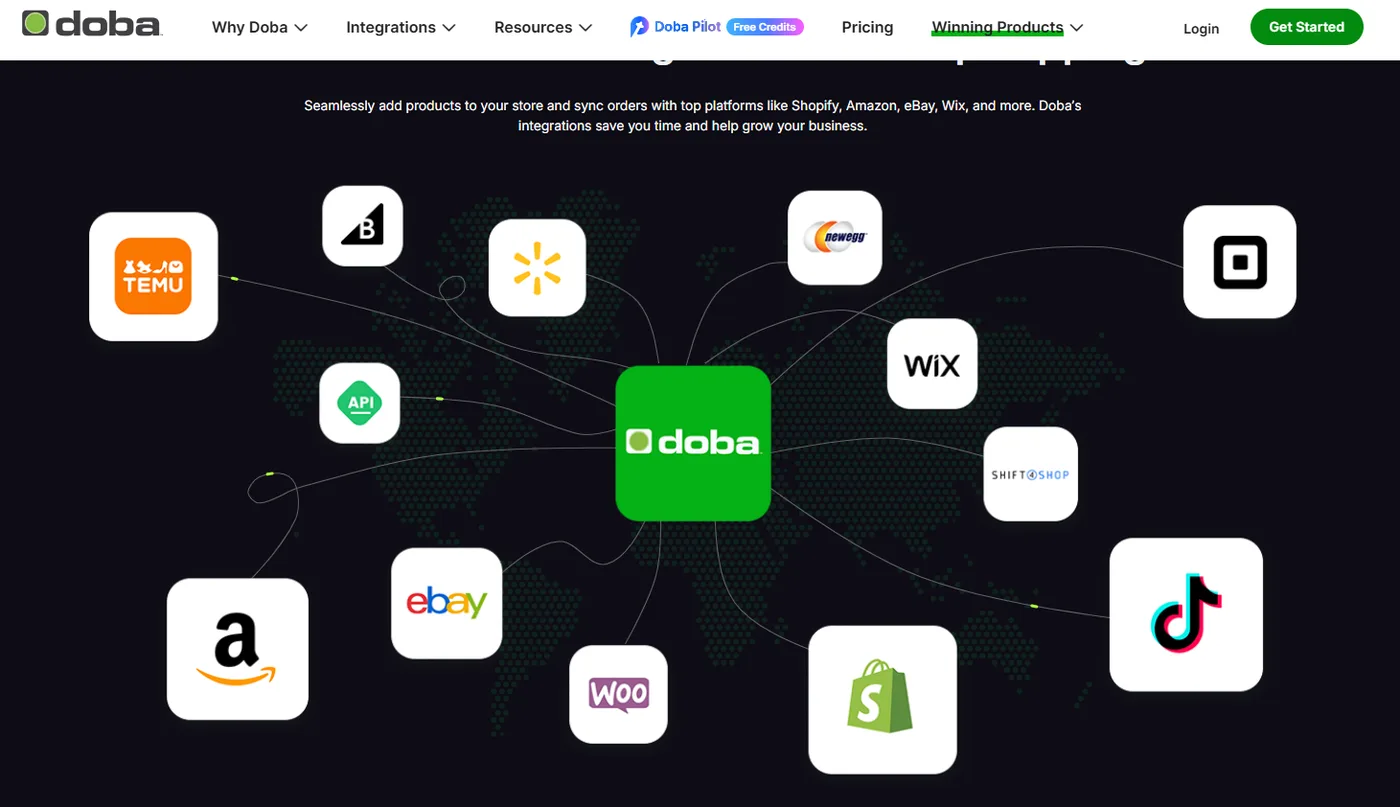
Doba is an AI-powered dropshipping operations platform with a catalog of over 1 million SKUs and a Shopify integration that keeps products, inventory, and orders in sync automatically. Doba says around 90% of its products ship from US-based warehouses, which supports faster domestic delivery on eligible products. Its standout feature is Doba Pilot, an AI agent that can help Shopify sellers build a store, find products, create listings, and manage orders in one place, all through plain-language chat; we break it down in detail in our best AI tools for dropshipping guide. Inventory sync helps you avoid selling products that are out of stock, and order sync cuts manual fulfillment errors. The rest of the catalog ships from overseas, so filter for US-warehouse items when shipping speed is your priority.
- Pricing: Registering an account is free and lets you browse the catalog; sourcing and automation features sit on paid plans with trial offers. Check current pricing on Doba's site.
- Best for: Sellers who want AI-assisted sourcing plus US-warehouse options, and stores consolidating sourcing, listing, and fulfillment in one platform.
Page builders (turn visitors into buyers)
Ready to start? Try Shopify free, then pay just $1/month for your first 3 months.
Start Your Free Shopify TrialNo credit card required to start · Cancel anytime
Shopify's default product pages are fine to start, but custom landing pages convert paid traffic far better. Page builders give you drag-and-drop control without code. If you want the deep dive on the two leaders below, our PageFly vs GemPages comparison puts them head to head.
6. PageFly: best flexible page builder for conversions
PageFly is the most-installed Shopify page builder, built around conversion-rate optimization. You can design product pages, landing pages, and full funnels with granular control over every element.
- Pricing: Free plan includes one published page with access to all core features and 24/7 live chat. Paid plans start around $24/month for more page slots, with an unlimited tier near $99/month.
- Best for: Sellers who want maximum design flexibility and don't mind a small learning curve.
7. GemPages: best AI-assisted page builder
GemPages is the friendlier of the two big builders, with strong AI features, including turning a reference image into an editable layout, that let beginners ship a polished page fast. It also supports post-purchase upsells and sales funnels on higher tiers.
- Pricing: Free plan with one published page. Paid plans start around $29/month (Build), with Optimize near $59/month adding funnels and upsells.
- Best for: Beginners who want professional pages quickly and like AI doing the heavy lifting.
Not sure whether you even need a builder yet? Start with our walkthrough on how to add products to Shopify and upgrade your pages once you have traffic to optimize.
Themes (your store's foundation)
8. Debutify: best conversion-focused theme
Debutify is a Shopify theme built specifically for conversions, with dozens of optional add-ons (trust badges, countdown timers, sticky add-to-cart, upsells) you can toggle on without separate apps. Bundling those into the theme can reduce app clutter and keep your store fast.
- Pricing: A free tier with basic features and a 14-day trial; paid plans start around $21-24/month for add-on access, with higher tiers unlocking more widgets.
- Best for: Dropshippers who want conversion features baked into the theme instead of installing many separate apps.
See our full Debutify review for a breakdown of what each add-on tier unlocks and whether it beats a free theme plus apps.
Many of Shopify's own free themes (like Dawn) are also excellent starting points, there's no shame in launching free and upgrading later. Our roundup of the best Shopify themes for dropshipping compares the strongest free and paid options.
Email & SMS marketing (own your customers)
9. Omnisend: best email & SMS app for ecommerce
Paid ads bring traffic once; email and SMS bring customers back for free. Omnisend is purpose-built for Shopify, with pre-made automations for abandoned carts, browse abandonment, welcome flows, and post-purchase follow-ups.
- Pricing: Free plan covers up to 250 contacts and 500 emails/month with all features included. The Standard plan starts around $16/month and scales with your contact count; the Pro plan (around $59/month) adds higher limits. SMS availability and credits vary by plan and signup date, so check current terms.
- Best for: Every store that wants to recover lost sales and build repeat revenue. Set up the abandoned-cart flow on day one.
Read our full Omnisend review for a deeper look at pricing tiers and setup mistakes to avoid.
Reviews & social proof (build trust fast)
Trust is the biggest barrier for new dropshipping stores. Reviews, especially photo and video, directly lift conversions.
10. Judge.me: best value reviews app
Judge.me is the budget-friendly favorite, with a generous free plan that includes unlimited review requests, photo and video reviews, and rich snippets for SEO.
- Pricing: Free plan covers the essentials; the paid plan is a flat ~$15/month with no per-order overage fees.
- Best for: Cost-conscious sellers who want strong features without usage-based surprises.
11. Loox: best for visual, photo-first reviews
Loox is the more polished, image-led option. Its widgets are among the best-looking in the category, and it actively incentivizes customers to leave photo reviews with discount triggers.
- Pricing: A free Beginner tier (reviews only); paid plans start around $9.99-$39.99/month, but several tiers include per-order limits, so costs can climb as you grow. Read the order caps carefully.
- Best for: Brand-focused stores willing to pay for the best-looking review experience.
Either app does the core job well, pick Judge.me for value and predictable pricing, Loox for visual polish.
Upsells (raise your average order value)
12. ReConvert: best thank-you page and post-purchase upsells
ReConvert turns your checkout and thank-you page into extra revenue with one-click upsells, cross-sells, post-purchase surveys, and reorder buttons. Because the offers appear after the customer has already paid, they don't hurt your conversion rate.
- Pricing: Tiered by order volume, starting around $4.99/month, plus a small percentage fee on the extra revenue the app generates. Costs scale with success, so factor it into your margins.
- Best for: Stores with steady orders that want to lift average order value without more ad spend.
How to build your app stack (without slowing your store down)
Every app adds code, and too many apps slow your site, which hurts both conversions and ad costs. Resist the urge to install everything. A lean, sensible order looks like this:
- Launch: A sourcing/fulfillment app (DSers or CJ Dropshipping) and a reviews app (Judge.me or Loox).
- Once you get traffic: A page builder (PageFly or GemPages) to optimize your best product pages.
- Once you make sales: Email/SMS (Omnisend) for abandoned carts, then an upsell app (ReConvert) to raise order value.
If you would rather run one app than several, Vitals bundles reviews, upsells, product bundles and trust badges into a single app with 40+ tools, which keeps the app count and page weight down. Our link gives you a 40-day free trial.
Test apps during your free trial, keep only the ones that earn their place, and uninstall the rest. For a deeper foundation, see our pillar guide on how to start dropshipping in 2026 and our launch checklist. Curious whether the whole model still works? Our honest take on whether dropshipping is worth it covers the trade-offs.
The bottom line
You don't need 30 apps to run a profitable dropshipping store, you need the right one for each job and the discipline to keep your store fast. Start with a sourcing app and reviews, then layer in pages, email, and upsells as you grow.
All of these install directly from the Shopify App Store, so the simplest next step is to get your store live. Start your free Shopify trial, add a fulfillment app, and import your first products today. Want to make sure the platform is right for you first? Read our breakdown of whether Shopify is legit and safe.
Frequently Asked Questions
What is the best app for dropshipping on Shopify?
There is no single best app, you need a small stack. For sourcing and order fulfillment, DSers and CJ Dropshipping are the most popular starting points. Most stores then add a page builder, an email tool, and a reviews app once they start getting traffic.
Are dropshipping apps free?
Many have genuinely useful free tiers. DSers, CJ Dropshipping, Omnisend, Judge.me, PageFly, and GemPages all let you start at $0. You usually pay only once you scale, need more product slots, or want advanced features.
How many apps do I need to start dropshipping?
You can launch with just two: a sourcing/fulfillment app to import and ship products, and a reviews app to build trust. Add a page builder, email/SMS, and upsell apps as your traffic and revenue grow, adding everything on day one slows your store down.
Do too many Shopify apps slow down my store?
Yes. Every app can add scripts that affect page speed, which hurts conversions and ad performance. Install only the apps you actively use, and remove ones you tested but abandoned to keep your store fast.
Which Shopify plan do I need to use these apps?
Almost every app on this list works on Shopify's entry-level Basic plan. You don't need a higher tier to start, you can install most of these during your free trial and test them before committing.
Ready to Start Your Store?
Try Shopify free, then pay just $1/month for your first 3 months.
Start Free TrialNo credit card required to start · Cancel anytime
Keep Reading
Printify Alternatives: 5 Print on Demand Options (2026)
Printify alternatives for 2026: Printful, Gelato, Gooten, Spreadconnect and Shopify's own POD apps, compared on quality, speed and cost.
AutoDS Alternatives: 5 Options Compared (2026)
AutoDS alternatives for 2026: free and cheaper ways to import products and fulfill orders on Shopify, compared honestly.
DSers Alternatives: 5 Options Compared (2026)
The best DSers alternatives for 2026: what to use when AliExpress-only sourcing stops being enough, compared with honest pricing.